AI Nodes (Tech)
AI Integration
Work begins with discovery, mapping workflows, data structures, decision logic, and requirements before any model is chosen. Tooling is selected to fit, not the reverse, whether commercial or open-source LLMs (Claude, GPT, Llama), RAG over proprietary data, MCP integrations, or orchestration layers like n8n. Models connect to APIs, databases, and business rules, with governance built in from the start. Human review is retained on decisions affecting access and compliance, backed by audit trails and clear data boundaries. Deployments run cloud, on-prem, or hybrid. The result is an intelligence layer woven into your existing workflows, shaped around how your team already works.
Human Skills That Scale With AI
As AI usage becomes increasingly prevalent, human skills such as trust, empathy, diplomacy, and synthesis become even more critical. Our commitment is to blend technical excellence with these essential human qualities, ensuring that we build systems that resonate with users. We understand that technology is only as good as the people behind it, which is why we prioritize collaboration and communication at every stage.
It's Our Craft
With decades of experience and thousands of successful projects, we excel at crafting solutions that are not only effective but also precisely tailored to fit specific operational contexts. We focus on the art of building systems that work seamlessly within the defined constraints while delivering high-quality results.
Unstructured Data AI Design
Designing AI for unstructured data starts with source analysis. From there, architects select appropriate models and techniques, including NLP pipelines for entity extraction, classification, and summarization, OCR for scanned documents, and embeddings for semantic search. System design addresses chunking strategies, vector storage, retrieval-augmented generation patterns, and confidence scoring. Production systems require schema mapping to connect extracted data to operational databases, feedback loops for model improvement, and governance controls for sensitive content. The goal is structured, reliable output from messy input.
Semantic Search
Semantic Search is a more elegant way to find information, using natural language processing (NLP) and machine learning to grasp the context and intent behind what you’re looking for. Unlike basic keyword searches that just match exact terms, semantic search looks at how words and phrases relate to each other, giving you more accurate and relevant results.
AI Shifts Work, Not Responsibility
As AI tools evolve and accelerate workflows, accountability remains unchanged. At Beezwax, we recognize that while technology can streamline tasks, it does not absolve teams of their responsibilities. Our commitment is to equip clients with the tools and understanding necessary to maintain high standards of accountability while leveraging AI effectively.
Every Stakeholder’s Voice Matters
Listening is at the core of what we do. We understand that often, successful projects require input from all stakeholders. Our collaborative approach ensures that every voice is valued. This leads to solutions that are not only well-informed but also embraced by all parties involved.
Business Forecasting
Forecasting uses data to predict potential outcomes as part of the basis for assessing risk and uncertainty. Forecasting is a vital component of organizational decision making.
Efficiency of Operations
Streamline processes so that less human effort can produce greater results. You are a force for progress in your business. Eliminate redundancies or overly complex processes and identify where existing systems can be enhanced through automation.
Recommendation Engine Development
Recommendation engines use algorithms to analyze vast datasets and user interactions. These systems use machine learning to personalize suggestions based on user patterns, preferences, and behaviors. The system uses algorithms to adapt to the user's intentions, thus improving their experience and engagement.
Retrieval Augmented Generation (RAG) Configuration
Retrieval-Augmented Generation (RAG) uses your organization’s data to improve the responses from a large language model (LLM). By using live data, RAG ensures that the responses are up-to-date, providing you with precise and timely insights.
Workflow Automation
Effective automation requires understanding organizational workflows, identifying bottlenecks, and ensuring outputs align with strategic goals. AI can accelerate repetitive tasks, but human judgment is key in interpreting results and making nuanced decisions. This dual approach ensures that automated systems are not only efficient but also adaptable and responsive to real-world complexities. Accountability for decisions made with AI tools remains with the team implementing them, reinforcing the need for skilled oversight. AI accelerates routine work and analysis, while human judgment governs interpretation, nuanced decisions, and accountability for results.
Amazon Web Services (AWS)
Amazon Web Services is Amazon's cloud computing platform, run on server farms worldwide and maintained by the Amazon subsidiary. Fees are based on usage along with the hardware, software, and service options a subscriber chooses. Customers can pay for a single virtual computer, a dedicated physical one, or large clusters, with security included in the agreement. AWS is widely considered the leading cloud platform, used by millions of customers including many of the largest enterprises. Its components are heavily modularized, and its Lambda functions can be written in many languages, including JavaScript, Ruby, Swift, or Python. Within Beezwax, our IT consulting team works with AWS on setup, deployment, security, scalability, and performance for systems that run your web, mobile, or desktop applications.
Python
Python is popular, open source programming and systems scripting language. Its capabilities extend to everything from managing servers and handling email, to integrating FileMaker with other platforms.
Claude Cowork
Anthropic's agentic desktop tool that lets non-developers automate file management and everyday knowledge work.
ChatGPT
ChatGPT is OpenAI's conversational AI assistant, widely used for generating text, answering questions, and drafting content. Through its API, we can build it into applications and workflows to handle tasks like drafting, summarizing, and answering customer questions.
DIY AI vs Governed Insight
The difference between self-serve experimentation and durable decision systems is significant. We provide structured guidance that helps clients navigate the complexities of AI implementation. By building governed insights, we ensure that organizations can make informed decisions that stand the test of time. Our legacy is rooted in quality and excellence, with a commitment to delivering solutions that truly matter.
Human-Centric Philosophy
We believe that the best solutions arise from understanding the people behind the processes. Our approach emphasizes listening to our clients, engaging in thoughtful dialogue, and collaborating closely throughout the development cycle. This human-centric philosophy ensures we build systems that are not only technically sound but also user-friendly and aligned with the goals of the organization. We prioritize the needs of end-users to create lasting value.
Quality is our Legacy
We take pride in the craftsmanship of our engineering solutions, knowing that even the details unseen by clients contribute to the overall integrity of the project. Our commitment to excellence drives us to follow industry best practices and proven methodologies, ensuring that our work stands the test of time. Whether you require full implementation or consultative support, we are equipped to meet your needs with precision and care.
Intelligent Web Scraper
Traditional web scrapers break when websites change their layout. This solution uses AI to dynamically adapt to structural changes and extract relevant information, sometimes verbatim, sometimes inferred.
A client relied on rule-based scrapers to pull structured data from third-party websites. Every time a target site changed its layout, the scrapers broke. The maintenance burden was constant, unpredictable, and growing. They needed a system that could adapt without manual intervention.
Challenge
The client monitored five to six different types of complex websites, each with its own structure, content patterns, and update frequency. Rule-based scrapers required individual maintenance for each site type, and a single layout change could break extraction entirely. The team was spending more time fixing scrapers than using the data they produced.
What We Built
We built an AI-powered scraper that dynamically adapts to structural changes in target websites. The approach centered on golden reference datasets: for each website type, we manually constructed perfect examples showing the AI exactly how to do the job. These references are fed dynamically at runtime using few-shot prompting, so the model generalizes across layout variations.
A validation flow compares extracted output against expected structure, routing failures to human review. Corrections update the golden dataset automatically, creating a continuous improvement loop. Infrastructure setup took two to three weeks. The remaining time was spent on AI tuning, data analysis, and building the validation flow.
What Changed
The system traded fragile, rule-based maintenance for an upfront investment in reference data quality. When a site layout changes, the system adapts on its own. The team stopped firefighting broken scrapers and started focusing on what the data tells them. AI-powered scraping trades constant maintenance for upfront investment in golden datasets. The quality of the reference data directly determines accuracy.
Recommendation Engine: Content Matching
Matching job postings to the right candidate websites from a large, constantly shifting pool. The business rules were dense, layered, and full of exceptions. An off-the-shelf solution would have ignored most of the nuance that mattered.
A media company needed to automate a content matching process that was consuming significant manual effort. The challenge was not finding similar content, it was defining what "similar" meant in their specific business context, where a good match depended on criteria that had never been formally documented.
Challenge
The matching criteria were complex and highly contextual. What made a candidate website a "good match" for a given job posting depended on relevance, context, and business-specific factors that varied across categories. These rules lived in the heads of experienced team members, not in any system. The technical challenge was less about building a recommendation engine and more about capturing and encoding domain expertise that had never been written down.
What We Built
We designed a scoring and ranking pipeline using embeddings to measure content similarity, then layered business-specific logic on top to handle the criteria that pure semantic matching would miss. The architecture separates the semantic layer from the business rules engine, allowing domain rules to evolve independently of the model.
Infrastructure took roughly three weeks. The remaining three months went into AI tuning and modeling business rules. The most interesting technical decision was spending the majority of effort not on model configuration, but on translating domain expertise into the scoring system.
What Changed
The system now processes candidate-matching at scale with accuracy the team trusts. Matches that previously required manual review surface automatically, with confidence scores that let the team focus their attention where it matters most. When business rules are complex, most time is spent translating domain expertise into AI behavior, not on infrastructure. That insight shaped every decision we made on this project.
AI-Enhanced Systems
Integrating AI into existing systems involves embedding model inference, retrieval-augmented generation, or classification pipelines into operational data flows and application logic. Architecture considerations include model selection, API vs. on-premise deployment, context window management, prompt versioning, and output validation. Data pipelines must support feature engineering, vector storage, embedding refresh cycles, and audit logging. Governance requirements address hallucination mitigation, human-in-the-loop controls, and model observability. Integration patterns connect AI outputs to FileMaker, Claris Connect, custom APIs, or downstream BI tooling without disrupting existing system behavior.
Back-End SEO
Unlike traditional SEO, which prioritizes visible elements, Back-End SEO begins within internal systems—data architecture, indexing efficiency, API structures, and CMS configurations. By refining these foundational elements, content distribution, URL structuring, and search placement become more organic and enduring. This granular approach—focusing on micro-level optimizations like metadata propagation and internal linking logic—builds a technically superior infrastructure. A strong back-end fosters a more sustainable and future-proof search presence.
n8n Consulting
n8n consulting focuses on architecting robust, scalable automation pipelines using the open-source n8n platform. Services include self-hosted setup, secure credential handling, custom node development, advanced error management, and integration across REST APIs, SaaS platforms, and legacy systems. Consultants deliver production-grade solutions using Docker, CI/CD, and cloud-native best practices. Ideal for businesses needing precise control and extensibility over their automation logic.
Predictive Analytics
Predictive analytics uses statistical modeling, data mining, and machine learning to analyze historical and real-time data in order to forecast future events. Common techniques include regression analysis, decision trees, neural networks, and time series analysis. By identifying correlations and patterns, predictive analytics estimates the probabilities of specific outcomes, helping organizations mitigate risks and optimize opportunities. To be effective, it requires high-quality data, careful feature engineering, thorough model validation, and ongoing performance monitoring to maintain predictive accuracy over time.
Large Language Model (LLM)
A type of AI model trained on vast amounts of text to understand and generate human language across a wide range of tasks.
AI-Assisted Generation with Human Engineering
We leverage AI tools to enhance our capabilities, but we never rely solely on technology. Our method combines AI-assisted generation with intentional human judgment and data governance. This blend of technology and human expertise positions us to deliver high-quality, actionable applications that drive meaningful outcomes for our clients.
Decisions Driven by Insight
At Beezwax, we understand that decisions are rarely straightforward. Our Beez act as trusted advisors, guiding clients through this complex landscape to help identify what truly matters. With decades of experience, we have honed our ability to listen and understand the nuances of each unique environment, ensuring systems align with strategic goals.
Thirty Years of Wisdom
With over three decades of experience, we have honed our craft in building tailored solutions that meet the specific needs of our clients. Our portfolio includes thousands of successful projects, each one a testament to our commitment to quality and excellence. We understand the intricacies of various industries and apply our extensive knowledge to solve complex challenges effectively. Our longevity in the field allows us to leverage proven methodologies that ensure sustainable results.
Human-Led AI Implementation
Successfully deploying AI at scale requires more than a simple prompt; it demands careful negotiation and alignment of interests. We excel at identifying multi-stakeholder needs, facilitating conversations that transform AI-generated signals into actionable insights that teams trust, adopt, and operationalize.
Dynamics & Development
At Beezwax, we adeptly navigate the complexities of organizational structures. With decades of experience and a track record of successful implementations, we understand the nuances that influence adoption and effectiveness.
Collaboration
Collaboration is more than a buzzword for us; it’s a practice we embody in every project. We recognize that diverse perspectives lead to richer solutions. By actively engaging with your team, we ensure that our approach is tailored to meet your specific context
Transparency
Our commitment to quality and excellence is evident in everything we create, reinforcing the legacy we aim to build together. We prioritize transparency in our processes and maintain open lines of communication throughout the project lifecycle.
Translating Ambiguity into Structure
Ambiguity can be a barrier to progress. Our expertise lies in distilling complex and vague concepts into structured frameworks that drive decision-making. With decades of experience across thousands of projects, we have honed our ability to navigate uncertainty and provide clarity.
AI and ML for FileMaker via Python
Python-based AI and Machine Learning packages will now be at your fingertips, directly from your FileMaker app. Imagine the possiblities.
AI Governance and Security Consulting
AI governance and security consulting evaluates risk across model selection, data access, prompt injection exposure, output validation, and system integration points. Engagements produce policy frameworks covering acceptable use, data classification, retention, and PII handling in AI pipelines. Technical controls include role-based access, audit logging, human-in-the-loop checkpoints, and output filtering. Assessments examine third-party API dependencies, data residency, and model provider agreements for compliance alignment. Deliverables typically include a risk register, governance policy documentation, technical control specifications, and a prioritized remediation plan mapped to the organization's existing security posture.
AI Training for Teams
AI technical training covers prompt engineering, API integration patterns, output validation, and workflow automation using tools such as n8n, Claude Cowork, and LLM APIs. Sessions include hands-on implementation exercises with real toolstacks, covering error handling, rate limiting, structured output parsing, and logging practices. Training also addresses governance requirements: hallucination mitigation, audit trail design, access controls, and human-in-the-loop checkpoint patterns. Content is tailored to participants' existing technical background and production environment.
Machine Learning Development
Artificial Intelligence and Machine learning utilizes your compiled datasets to 'learn' and perform tasks. As the technology evolves and expands, AI becomes less out of reach and more actionable. In fact, the website that you are looking at right now has AI built into it. Lucky for me, the text is still written by a human... for now, at least.
Workflow Intelligence with Claude Cowork
Work begins with process discovery: mapping real operational flows across teams, not org charts or documentation. Claude is then connected to existing systems via MCP (Model Context Protocol) plugins that encode business rules, terminology, and data access as reusable tools. Cowork provides the execution layer, linking Claude to your other systems, APIs, and internal documents in plain language. Workflow redesign reduces steps and clarifies ownership. Selective automation targets repeatable, rules-based work. Human decision points are preserved by design, not bolted on after the fact.
PostgreSQL
PostgreSQL is a mature, open-source relational database. It is popular as a backend for web applications because it is reliable, handles complex queries well, and supports advanced features like JSON storage and full-text search. It scales from small projects to large systems.
AWS S3
Amazon Simple Storage Service, or S3, is an object storage service built for scale, availability, and security. Customers of all sizes use it to store and protect almost any amount of data, for uses such as websites, mobile apps, backups, archives, IoT devices, and big data analytics.
FileMaker Data API
The Data API supports modern web standards like REST and JSON, expanding the ways web services, local applications, and cloud-based systems can connect to the FileMaker Platform.
FileMaker
A low-code platform for building custom database apps that share one solution across desktop, web, and mobile.
The Alphabet Before the Story
Before diving into AI-driven insights, we emphasize the importance of schema, semantics, and governance. Our team listens to clients, ensuring we understand their unique contexts and needs. By establishing a solid foundation, we craft tailored solutions that enhance decision-making processes, rather than merely providing superficial analyses.
Data is Our DNA
At Beezwax, data is at the core of everything we create. We build systems that not only manage data but transform it into actionable insights. Our expertise in data architecture, analytics, and visualization empowers organizations to make informed decisions. By focusing on the unique data needs of each client, we craft customized solutions that address their specific requirements, enhancing their operational efficiency and strategic capabilities.
Accelerated AI Adoption
Explore how AI-driven search capabilities can transform data management and decision-making in FileMaker solutions.
Avoid AI Technical Debt
Moving fast with AI is easy. Living with brittle automation and tangled data later is not. We build it correctly the first time, so you are not paying to untangle it next year.
Build AI Fluency on Your Team
The tools change quickly. A team that understands how to use them well does not. We help your staff get genuinely comfortable putting AI to work in their daily jobs.
Get Your Data AI-Ready
AI is only as good as the data underneath it. We help you structure, clean, and connect your information so it is ready to support smart features, instead of quietly holding them back.
Introduce AI Responsibly
You want AI in your systems, but not at the cost of control. We help you add it where it earns its place, with governance and security designed in from the start, so the result is something you can actually run.
Keep Judgment Human
AI is great at drafting, sorting, and surfacing. The decisions that matter still belong to your people. We design systems where AI does the legwork and humans stay in control of the call.
Pilot AI With Less Risk
You do not have to bet the business to find out if AI fits. We build a focused prototype inside one real workflow, prove the value, and only then scale what works.
Set AI Guardrails
Who can use which AI features, on what data, with what oversight? We help you answer those questions and build the policies and controls into the system itself, not just a document nobody reads.
AWS Lambda
AWS Lambda lets you run code without provisioning or managing servers, and you pay only for the compute time you use. You upload your code, and Lambda handles running and scaling it with high availability. It can be triggered by other AWS services or called directly from a web or mobile app.
AWS EC2
Amazon EC2 is Amazon's virtual server service. It lets you start up compute capacity on demand and pay for what you use, without owning physical hardware. You can choose the size and type of machine to match the workload, and scale up or down as needs change.
OpenAI API
The programmatic interface for accessing GPT and other OpenAI models, enabling developers to build AI-powered applications.
Where AI Breaks Down
Artificial intelligence has its limitations, particularly in areas like hallucinations, shallow narratives, and context blindness. Our approach at Beezwax acknowledges these challenges head-on. With decades of custom software development experience and a proven track record, we create solutions that prioritize accuracy and relevance, enabling organizations to navigate the complexities of AI effectively.
High-Level Talent & Community Leadership
Our team is composed of high-level talent with diverse expertise across various disciplines. This depth of knowledge enables us to tackle projects with precision and skill. Beyond our client work, we are dedicated to community leadership, sharing insights and best practices that elevate industry standards. Our commitment to professional development and mentorship is a part of a culture of excellence that resonates throughout our organization... and beyond.
AI-Assisted Reporting Systems
AI-assisted reporting integrates LLM inference into reporting pipelines to generate narrative summaries, anomaly callouts, and contextual analysis alongside structured output. n8n orchestrates data retrieval, prompt construction, and API calls into automated sequences triggered by schedule or event, connecting source systems, AI services, and delivery endpoints without custom code overhead. Prompt templates are version-controlled and parameterized against live data at runtime. Output is routed to email, Slack, dashboards, or written back to source systems. Human-in-the-loop review steps and structured logging keep outputs auditable and correctable.
FileMaker AI
Leverage the versatility of Claris FileMaker Pro by integrating AI capabilities for enhanced data processing. AI integration allows for advanced features such as natural language processing (NLP), machine learning models, and predictive analytics within the FileMaker environment. The AI-driven possibilities for your Application are nearly limitless, including automated categorization, pattern recognition, and workflow optimization, making the platform a more powerful tool for managing relational databases. It can interact seamlessly with APIs and cloud-based AI services to extend functionality beyond traditional database operations.
Machine Learning Integration
Machine Learning involves training algorithms on data to identify patterns, optimize functions, and predict outcomes. It encompasses supervised, unsupervised, and reinforcement learning approaches. Core models range from linear regression to deep neural networks, utilizing techniques such as gradient descent, feature engineering, and cross-validation. ML enables adaptive systems in real-time analytics, automation, and intelligent decision-making.
JSON
A language-independent and standardized format for constructing data objects with name-value pairs. JSON is used extensively to pass data between applications of all types.
Claude Code
Anthropic's command-line coding agent that lets developers delegate software tasks directly from their terminal.
OpenAI GPT
GPT-4 is OpenAI's large language model, known for handling complex reasoning, coding, and instruction-following tasks. Developers reach it through OpenAI's API to add natural language features to their own applications, from support assistants to content tools. It works with text and, in some versions, images.
Claude (Anthropic)
Anthropic's AI assistant, designed with a focus on safety, nuanced reasoning, and genuinely helpful conversation.
Elasticsearch
Elasticsearch is a distributed search engine that finds close matches, not only exact ones, and searches across multiple data sets at once. It handles large volumes of data quickly, which makes it a good fit for application search, logging, and analytics.
Anthropic API
The Anthropic API is the programmatic interface for integrating Claude into applications, giving developers direct access to Anthropic's AI models. Applications send text and other input through the API and receive generated responses, which supports features like chat, summarization, extraction, and tool use. It lets teams add language and reasoning capabilities without hosting a model themselves.
Kubernetes
An open-source system for orchestrating containerized applications across clusters of machines.
LangGraph
A framework for building stateful, graph-structured LLM agent workflows on top of LangChain.
Context Matters
While AI can analyze data at scale, it lacks the empathy and the contextual understanding that comes from real-world experience. Our team brings a wealth of knowledge and a sensitivity to the unique challenges faced by our clients. We are dedicated to building relationships based on trust, allowing us to navigate sensitive contexts effectively. This human touch ensures that our recommendations resonate on a deeper level.
Role-Based Systems
Our role-based systems are designed to accommodate conflicting needs and diverse departmental perspectives. By working in this way, we provide organizations with the resilience to handle nuanced disagreements without compromising the integrity of the systems we craft.
Claris MCP Deployment
A Model Context Protocol (MCP) server exposes FileMaker data and operations as callable tools for AI systems. Configuration involves defining resource endpoints, mapping FileMaker layouts and scripts to MCP tool definitions, and managing authentication via the FileMaker Data API. Once deployed, AI assistants can query records, execute scripts, and return structured data within conversational or automated workflows. Deployment considerations include scope controls to limit AI data access, logging for auditability, and environment management across development and production instances. The result is a governed, queryable interface between FileMaker and any MCP-compatible AI client.
MySQL
MySQL is one of the most popular database backends for web and mobile applications. It’s a solid and mature choice, although these days we work with many alternatives.
Databricks
A unified analytics platform built on Apache Spark, combining data engineering, machine learning, and collaborative notebooks.
Google provides a broad range of cloud services and developer APIs. Through them, custom business applications can integrate features like Calendar, Docs, Search, Gmail, Translate, and Maps. We can extend the systems you already run by connecting them to the Google services your team depends on.
Streamlit
A Python framework for turning data scripts into interactive web apps with minimal front-end work.
Llama (Meta)
Meta's family of open-weight large language models, widely used for research, fine-tuning, and on-premises deployment.
Grafana
An open-source observability platform for visualizing metrics, logs, and traces from virtually any data source.
Gemini (Google)
Gemini is Google's family of multimodal AI models, built to reason across text, images, code, and audio in one system. It runs behind Google products and is offered to developers through an API. The models come in different sizes to fit uses from lightweight tasks to complex reasoning.
AWS SageMaker
AWS SageMaker is Amazon's managed platform for machine learning. It brings together the steps of preparing data, training models, and deploying them at scale in one place. Teams use it to move a model from experiment to production without assembling all the infrastructure themselves.
AWS Bedrock
AWS Bedrock is a managed service from Amazon for working with foundation models from providers such as Anthropic, Cohere, and Meta. It exposes those models through one API, so teams can add generative AI features to applications without running the underlying infrastructure themselves.
Snowflake
Snowflake is a cloud data warehouse that runs on AWS, Azure, and Google Cloud. It scales storage and compute independently, which keeps big analytical queries fast without slowing down other work. Companies use it to centralize data and share it across teams and tools.
Collibra
A data governance platform that helps organizations catalog, classify, and trust their data assets.
LangChain
A framework for building applications that chain together LLM calls, tools, and data sources into coherent workflows.
Hugging Face Transformers
An open-source library providing thousands of pre-trained models for NLP, vision, and audio tasks.
Gemini API
The Gemini API is how developers reach Google's Gemini models from their own code. It handles requests for tasks like text generation, summarization, reasoning, and image understanding, and returns results an application can use. It is the building block for adding AI features to custom software.
dbt
A SQL-based transformation tool that brings software engineering practices like version control and testing to data modeling.
AutoGen
AutoGen is an open-source framework from Microsoft for building multi-agent AI systems. It lets multiple models and tools communicate and divide up work, so a group of agents can solve tasks that would be hard for a single model alone.
Apache Spark
Apache Spark is a distributed data processing framework built for fast, large-scale analytics and machine learning workloads. It spreads computation across a cluster and keeps data in memory where possible, which speeds up jobs over very large datasets. It supports batch and streaming work and offers libraries for SQL, machine learning, and graph processing.
TensorFlow
Google's open-source machine learning framework, widely used for building and deploying neural networks at scale.
Foundation Model
A large AI model trained on broad data that can be adapted for many downstream tasks through fine-tuning or prompting.
Weaviate
An open-source vector database that combines semantic search with structured filtering and built-in ML model integrations.
Chroma
An open-source vector database built specifically for storing and querying embeddings in AI applications.
BigQuery
BigQuery is Google Cloud's serverless data warehouse built for analytics at scale. It runs SQL queries across massive datasets quickly, without any infrastructure to manage, which makes it a good fit for reporting and analysis on large volumes of data.
LlamaIndex
A framework that indexes your own data so language models can retrieve and answer questions against it.
AI Ethics and Fairness Consulting
Expert guidance to organizations on the ethical implications of AI technologies. This service includes identifying and mitigating biases in algorithms, ensuring compliance with ethical standards, and promoting fairness across AI systems. The process includes analyzing data, handling practices, evaluating decision-making, and providing frameworks for transparency and accountability. Trust in AI begins with aligning regulatory requirements and ethical guidelines to safeguard against discrimination, privacy violations, and unintended consequences.
MongoDB
A document-oriented NoSQL database designed for flexible, schema-free storage of JSON-like data at scale.
Microsoft Azure
Azure, like AWS or Google Cloud, is a cloud computing offering from Microsoft for building, testing, deploying, and managing applications and services through a global network of managed data centers. It supports many different programming languages, tools and frameworks, not only Microsoft-originated languages, but open source platforms like JavaScript, Python and Swift.
Julia
A high-performance language designed for scientific computing, combining Python's usability with speeds much closer to C.
Grok (xAI)
Grok is xAI's large language model. It handles conversation and text generation like other modern language models, with the added feature of real-time access to data from X and a direct, informal tone.
NumPy
The foundational Python library for numerical computing, providing fast array operations that underpin most data science work.
Automated Workflows
Automated workflows are sequences of tasks that are executed based on specific rules, allowing them to operate across different systems or applications without requiring manual effort. By utilizing APIs, triggers, and conditional logic, these workflows integrate various tools. They automate processes like data flow, notifications, approvals, and deployments. This automation enhances operational efficiency, reduces latency, and supports scalability in enterprise environments.
Integrate LLMs
AI Chatbot
An AI chatbot is a software application that uses natural language processing and machine learning to simulate human conversation.
Recommendation Engine
AI Call Logging in Action: Track, Analyze, and Optimize AI Interactions
This screenshot showcases bzAICallLogging-FM in action, capturing AI call logs in FileMaker. The log details token usage, similarity thresholds, and iterative semantic searches, helping developers fine-tune AI-driven queries. By analyzing these logs, users can optimize search accuracy, manage costs, and troubleshoot AI behavior efficiently.
AI-Powered System Integration
Information and tools were siloed across multiple platforms. AI bridges these systems and enables intelligent cross-platform workflows, turning four separate tools into one coherent view.
Teams were spending significant time manually moving information between project management, source control, team messaging, and credential storage. Context was lost in translation. Nobody had a complete picture of what was happening across systems without checking each one individually.
Challenge
The problem was not that these platforms lacked APIs. They all had them. The challenge was building reliable connections that handle authentication, rate limiting, error recovery, and data format differences across four distinct platforms, then adding an intelligence layer that could route, summarize, and surface the right information to the right people at the right time.
What We Built
We built a workflow orchestration layer using n8n that connects Slack, Wrike, GitHub, and 1Password. An AI layer handles intelligent routing and summarization across systems. About 30% of the effort went into the AI component: routing logic and summarization prompts. The other 70% went into integration plumbing: API connections, OAuth flows, error handling, and retry logic across platforms.
Redis provides caching for workflow state. PostgreSQL stores structured output and audit logs. The system produces automated actions and cross-platform insights without requiring anyone to manually check four different tools.
What Changed
Teams now get cross-platform visibility without tab-switching. Automated workflows handle routine information routing, and AI-generated summaries surface what matters across systems. Integration projects are less about AI complexity and more about connecting systems reliably. The AI adds intelligence to routing and summarization, but integration plumbing is the bulk of the work.
Conversational Analytics
Let non-technical users query their data using natural language. The data was constrained, the business domain was well-defined, and the goal was an MVP with iterative improvements, not a full analytics platform.
A client's operational team needed to answer business questions from their data warehouse without writing SQL or waiting for a report from the analytics team. The data was well-structured, and the business domain was clearly defined, making it a strong candidate for a natural language interface.
Challenge
The technical challenge was not building a query engine from scratch. It was teaching an AI system what the data actually means in a specific business context. Column names, metric definitions, and business rules needed to be captured in a semantic layer that translates natural language questions into accurate database queries. Without that layer, the system would return technically correct but business-wrong answers.
What We Built
We used a managed analytics platform that acts as an orchestrator between a front-end application, a semantic layer, and a Snowflake data warehouse. The semantic layer holds business context, data mappings, metric definitions, and query templates. Pre-built front-end templates minimized UI development.
About 20% of the project effort went into platform setup and integration. The other 80% went into semantic layer configuration: business context definition, data mapping, query tuning, and template customization.
What Changed
Operational team members can now get answers to business questions directly, without SQL and without waiting for the analytics team. When a managed platform fits the use case, it dramatically reduces effort. The work shifts from building infrastructure to configuring the semantic layer, which is where the real business value lives.
Content Analysis - Statement Detection
Automatically detect incorrect text statement or unverified test results across a large volume of articles, link them to product documentation, and give editorial teams the ability to override any AI decision at any stage.
An editorial organization needed to scale a content review process that was entirely manual. The volume of articles exceeded what the team could review by hand, but the sensitivity of the content required human judgment at every decision point. They needed AI to handle the volume while humans retained control.
Challenge
The business rules governing what constituted “incorrect”, “incomplete” or “unverified” info were complex, contextual, and constantly evolving. Different content categories had different sensitivity thresholds. The editorial team needed to see exactly why the AI flagged something, override it when the AI was wrong, and have those corrections improve future performance. Building a black-box detector was not an option.
What We Built
We broke the problem into five sequential stages: content parsing, statement detection, semantic similarity checking against a vector store, confidence scoring, and linking with structured output. AI makes suggestions at each step. A human override interface sits at the end, and every correction feeds back into a golden dataset, improving performance over time.
The architecture required deep immersion in the business before any code was written. Understanding how the editorial team defines and categorizes sensitive content shaped every design decision. Roughly a third of the total team effort was on the AI side. A significant portion went into building golden datasets and evaluation flows that test each pipeline stage independently.
What Changed
The editorial team can now review content at scale without sacrificing the judgment calls that matter most. Complex editorial workflows benefit from decomposition into discrete AI-assisted stages. Budgeting time for evaluation infrastructure is what gives stakeholders confidence that the system is working correctly and improving over time.
Document Parsing & Data Cleansing
Parse structured data from PDFs and use AI to fix extraction errors. The documents followed predictable formats with minor variations, but even small errors compounded quickly downstream.
A client needed to extract structured data from a set of PDF documents and load it into their operational database. The PDF formats were consistent, with variations in the single digits, but the data entry process was manual, slow, and error-prone.
Challenge
Rule-based PDF parsing could handle the basic extraction, but consistently missed edge cases: formatting inconsistencies, OCR artifacts, and structural variations that were rare individually but frequent in aggregate. These errors went undetected until they caused problems in downstream reporting. The client needed a system that could catch what rule-based parsing could not, without requiring a large infrastructure investment.
What We Built
We used Python-based PDF parsing as a first pass, then an LLM to clean and correct the extracted data. Because the document formats were constrained, the AI layer stayed narrow and focused on error correction rather than open-ended interpretation. Validation compares results against a curated golden dataset, routing mismatches to human review.
The infrastructure was minimal: the Python layer lives on the same server as the client's FileMaker system, keeping costs low. Half the project effort went into building and validating the golden dataset. The other half covered logic, prompts, and AI unit tests.
What Changed
Data extraction errors dropped significantly, and the manual review burden was reduced to a small percentage of documents the system flags as low-confidence. Even on a project this contained, the golden dataset was the foundation that made everything else trustworthy. Even "simple" AI extraction projects require rigorous validation data.
Managed AI Server - Developer Platform
A shared AI backend so developers across the organization can add AI capabilities without managing infrastructure. One platform serving RAG, document ingestion, and content generation to every team.
Developers across the organization wanted to add AI features to their applications, but each team was standing up its own infrastructure independently. The result was duplicated effort, inconsistent implementations, and no shared patterns for common capabilities like document ingestion or retrieval-augmented generation.
Challenge
Every team was solving the same infrastructure problems from scratch: choosing a vector store, building ingestion pipelines, designing API contracts, and deploying model endpoints. The inconsistency made it difficult to maintain quality or share learnings across projects. The organization needed a centralized platform that provided AI capabilities as a service without creating a bottleneck for individual teams.
What We Built
We built a centralized API server using FastAPI that provides AI capabilities to consuming applications. Features include retrieval-augmented generation with Qdrant for vector storage and PostgreSQL for metadata, document ingestion with chunking and embedding generation, and email template generation.
About 25% of the project effort went into infrastructure: Docker, database setup, and vector store configuration. The remaining 75% went into application logic: the RAG pipeline, document ingestion workflows, template design, and API contracts. Docker-based deployment supports horizontal scaling as demand grows.
What Changed
New teams can now add AI features through a clean API without managing their own model infrastructure. Centralizing AI infrastructure reduced per-project overhead and ensured consistency. The investment pays off across every downstream application, and the platform continues to grow as new capabilities are added.
Predictive AI - Project Hours Estimation
Predict the number of hours required to complete a project, empowering better planning, scheduling, and resource allocation. This is not generative AI. It is predictive AI, and its feasibility depends entirely on the quality of historical data.
An interior design firm needed to move beyond gut-feel project estimates. They had years of historical project data and wanted to use it to forecast how long future projects would take based on project characteristics, scope, and complexity.
Challenge
Predictive AI projects live or die by data. Unlike generative AI, where you can iterate on prompts and reference data, a predictive model's performance is bounded by the quality, volume, and granularity of the training set. If the historical data lacks consistency or detail, no algorithm can compensate. The first question was not "which model should we use?" It was "is the data good enough to support reliable predictions?"
What We Scoped
We designed a machine learning solution using time series prediction frameworks like XGBoost and scikit-learn, packaged in a Python service with FastAPI and Docker. The model would train on historical project data to predict future project durations based on project characteristics. A mandatory pre-engagement data assessment evaluates whether the historical data can support the predictions the business needs.
The data assessment comes first and determines whether the project proceeds, pivots, or pauses while the client improves their data collection.
The Opportunity
Project estimation that currently depends on experience and intuition can become data-driven and consistent. The pre-engagement data assessment is not a formality. It is the single most important step in any predictive AI initiative, and it is a pattern we recommend regardless of the specific problem being solved.
Recommendation Engine - Provider Matching
Recommend the best service providers based on an office's location, proximity, contract recency, quality ratings, availability, and other business dimensions. Data lives across ERP and business intelligence platforms.
A facilities management organization needed to streamline its process for selecting service providers for office locations. The decision involved multiple factors, from geographic proximity to contract history to quality scores, and the data supporting those decisions lived in separate systems that did not talk to each other.
Challenge
The core difficulty was not the AI model. It was defining what "best provider" means in different contexts. An office in one region might prioritize proximity, while another might prioritize contract recency or quality ratings. The business logic governing provider selection was multi-dimensional and context-dependent, and the data needed to support those decisions was spread across Tableau and SAP.
What We Scoped
We designed a Python-based recommendation service with a FastAPI server layer, integrating with Tableau for visualization and SAP for provider and contract data. The AI component handles multi-dimensional scoring across location, quality, availability, and relationship history. The AI effort focuses on encoding business rules into a scoring system that reflects how the organization actually makes provider decisions.
The Opportunity
Provider selection that currently depends on institutional knowledge and manual lookups can become systematic and consistent. The challenge is encoding what "best provider" actually means in different business contexts, and that encoding work is where the value of the engagement lives.
Structured Data Extraction
Extract structured data from scanned or digital bills across four complexity tiers, from simple invoices to multi-page documents with nested tables, multi-currency charges, and poor scan quality.
A finance team was manually processing bills and invoices that ranged from clean digital documents to barely legible scans with complex table structures. The volume was growing, accuracy requirements were high, and the existing process could not scale.
Challenge
The document complexity spans four tiers. Simple invoices are easy to parse. Multi-page documents with nested tables, multi-currency charges, and degraded scan quality are not. A single extraction approach cannot handle the full range efficiently. The team needed a solution that could adapt to document complexity while keeping costs manageable for high-volume, low-complexity documents.
What We Designed
We proposed two parallel tracks. The Vision LLM track renders bills as images, segments them into a grid, and processes each segment in parallel with a vision-capable model, followed by a validation pass. No model retraining needed. It handles edge cases well but carries higher latency (5 to 15 seconds) and token costs.
The Traditional OCR track fine-tunes a domain-specific model on annotated samples. Faster and cheaper to run, but requires retraining when new bill types are introduced. Both tracks route low-confidence extractions to human review, and every correction feeds back into the system automatically.
The Opportunity
The design gives the team a clear choice between flexibility and cost, with a shared human-in-the-loop layer regardless of which track they choose. Both paths produce structured data that flows directly into downstream systems, and the feedback loop means accuracy improves with every document processed.
AI Call Logging & Tracking
Automatically records AI interactions for improved debugging and transparency.
Create an AI Advantage
Your competitors are bolting AI onto whatever they have. You can do better by building it into systems designed for the way you actually work, and pulling ahead while they patch.
bzSemanticSearch-FM
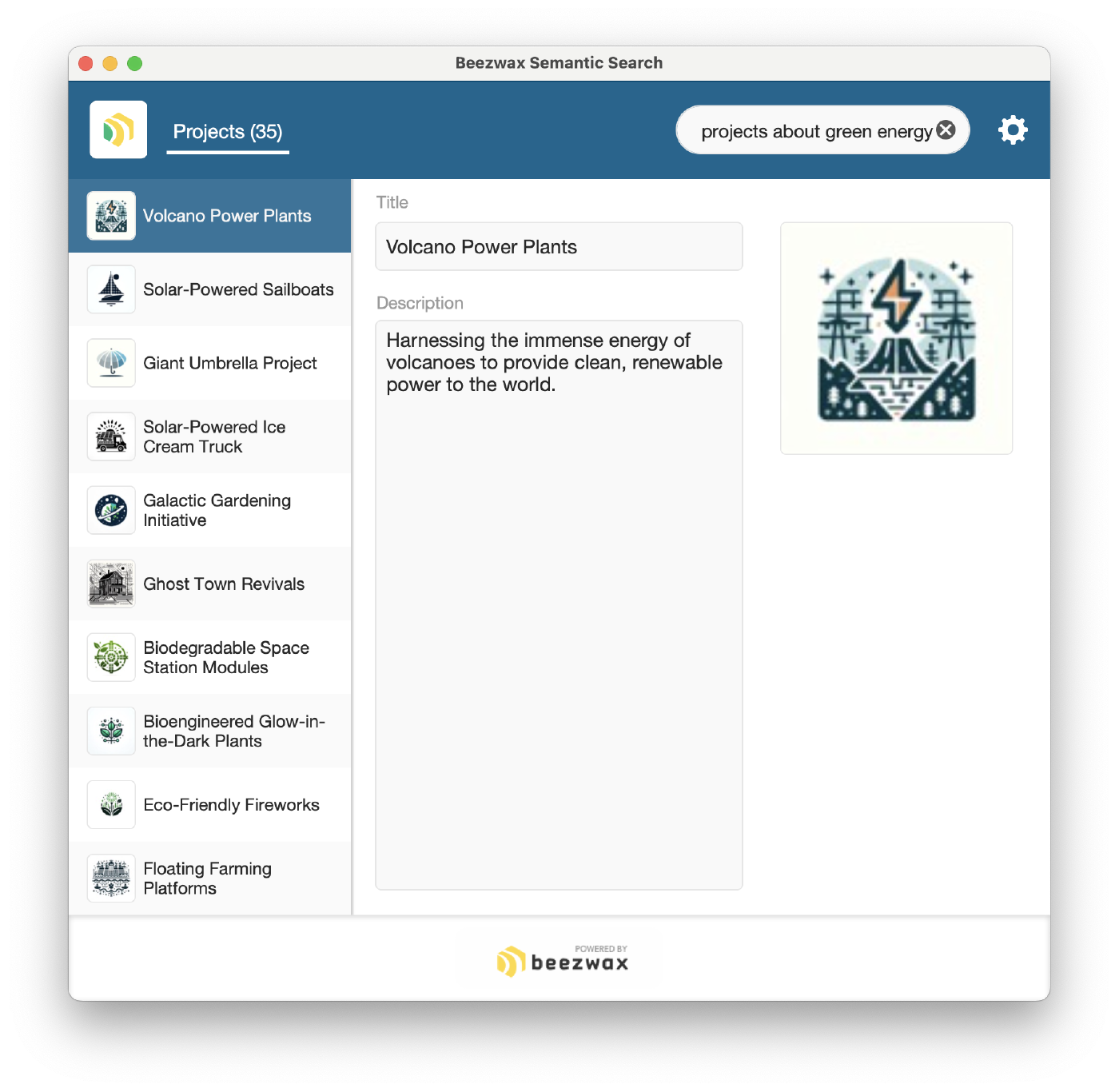
bzSemanticSearch-FM is a demo file designed to explore the semantic search functionality introduced in FileMaker. This file offers a practical way to learn, experiment, and implement this innovative feature in your solutions.
Semantic search goes beyond traditional FileMaker searches by understanding the context and meaning of terms rather than relying on exact matches. This enables more accurate and relevant results to enhance your workflows.
Download bzSemanticSearch-FM to start incorporating semantic search into your projects. This demo file provides practical tools and examples to streamline and improve your approach.
Learn more in our FileMaker Semantic Search blog series:
bzTrainer-FMDAPI-2024
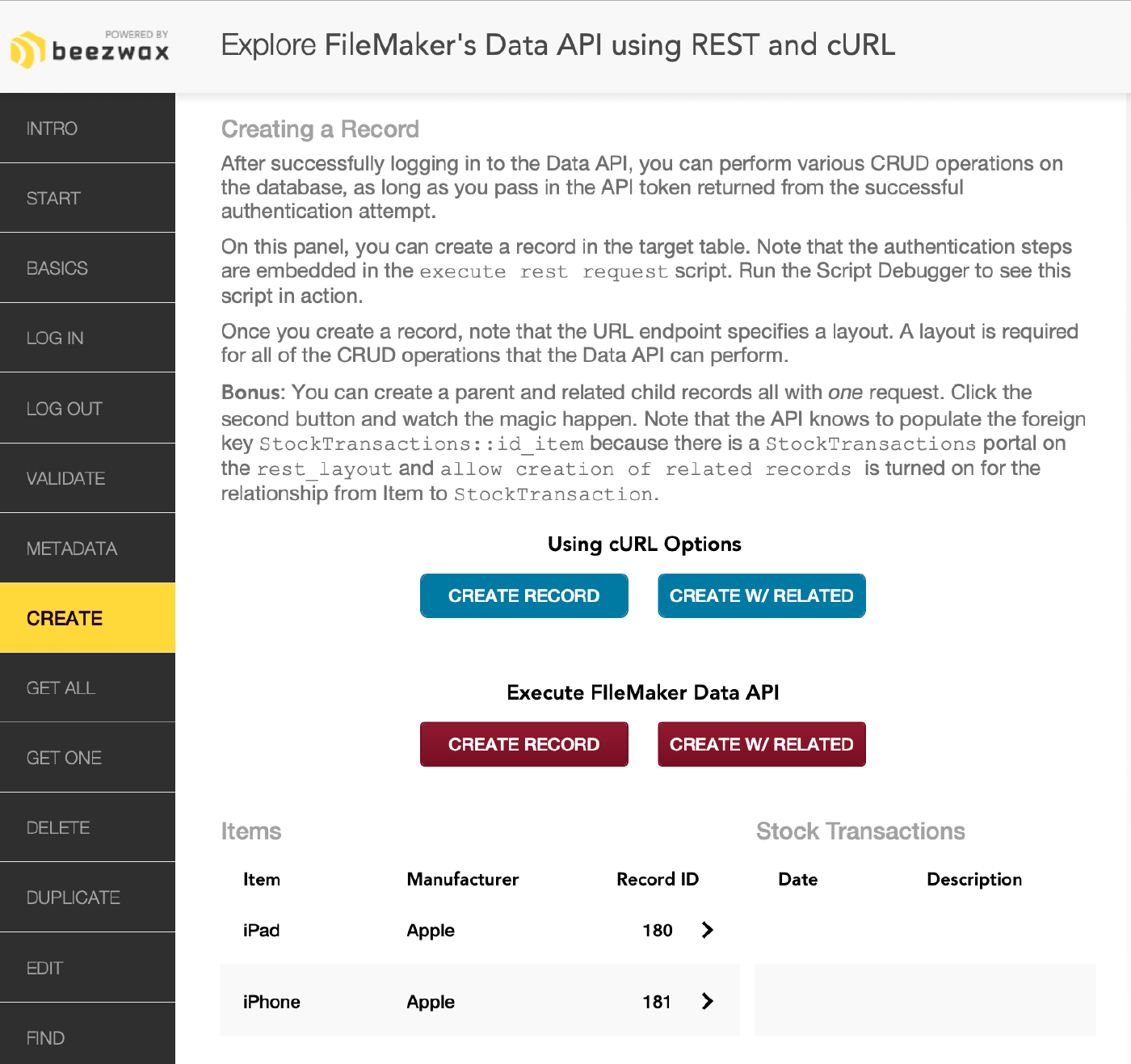
Discover the potential of FileMaker’s Data API with bzTrainer-FMDAPI-2024, a free tutorial file designed to help you explore and master this powerful feature. The Data API enables seamless integration with web services, task automation, and real-time data sharing across platforms — key capabilities for creating connected, efficient workflows in FileMaker.
bzTrainer-FMDAPI-2024 offers practical, hands-on exercises to guide you through implementing the Data API in your solutions. From automating repetitive tasks to integrating web services, bzTrainer-FMDAPI-2024 simplifies the learning process with clear, actionable examples. For a deeper dive, check out our blog post on using REST and cURL with FileMaker 2024 Data API.
Get to Know the Data API
Explore the evolution of the FileMaker Data API through our blog posts. Click on each version to dive deeper into its features and enhancements:
FileMaker 16 (Beta): The Data API debuts in beta, offering early access for developers.
FileMaker 17 (Official Release): The first official release introduces 10 endpoints.
FileMaker 18 (Enhanced documentation): New metadata endpoints and improved documentation.
FileMaker 19 (Automation Made Easy): Adds an authentication endpoint and Execute Data API script.
FileMaker 2023 (v20): Introduces date formatting, Save as PDF, and bug fixes for improved scalability.
FileMaker 2024 (v21): Adds CRUD operations, enhanced validation, admin tools, and cURL support.
Prompt Engineering
Effective prompt engineering applies structured techniques to control LLM behavior. The process requires understanding tokenization, context windows, temperature settings, and model-specific response tendencies. Advanced methods include retrieval-augmented generation (RAG) for grounding outputs in source data, tool-use patterns for agent workflows, and evaluation frameworks that measure output quality against defined criteria. Results improve through systematic A/B testing, prompt versioning, and feedback loops tied to production metrics.
Reconnect.Brisbane – AI with FileMaker 2024 and The Collaborative Journey
Katherine Russell and Vince Menanno from Beezwax present at Reconnect in Brisbane, Australia.
Beezwax is proud to sponsor and present at Reconnect.Brisbane, one of the biggest Claris FileMaker Developer conferences in the Asia-Pacific region this year. We're excited to gather with our peers in the Claris community, and for the chance to engage in presentations and discussions on the latest development trends, especially AI with FileMaker.
At Reconnect 2024, Katherine Russell and Vince Menanno from Beezwax will kick off developer presentations with two sessions:
- AI with FileMaker 2024: Get More Out of Your Data and Apps
- The Collaborative Journey: Evolving Through Code, Teams, and Technology

AI with FileMaker 2024
Get More Out of Your Data and Apps
Speaker: Katherine Russell, Senior Developer, Beezwax
Date: September 5, 2024
Time: 12:00 - 12:45, AEST
Summary:
- Introduction to semantic search and its benefits in FileMaker 2024
- Overview of native AI script steps and calculations
- Practical demos of how to implement semantic search and optimise embeddings for speed and cost-effectiveness
- Real-World Applications: Adding natural language search, making PDFs searchable and getting real-time summaries of scripts
FileMaker 2024's AI and semantic search capabilities benefit users as well as developers, providing more meaningful insights into solutions. Without changing data or workflows, you can enhance search accuracy, improve search relevance and report semantic outliers for users. And as a dev, you can even get a descriptive summary of that long string of sub-scripts in that file you just inherited. This session is a zippy introduction to the new functions as well as the concepts behind them – semantics and embeddings.
About The Speaker
Katherine Russell is a Claris/FileMaker Certified Developer specialising in initial project design, complete production, and adaptation of existing systems to new business goals. She also has expertise in hardware, networking and FileMaker integration issues, while more recently exploring the emergence of AI. She is a Senior Developer at Beezwax Datatools and previously worked with NightWing Enterprises in Melbourne, as well as in her own FileMaker consultancy in the US. One of her missions is to save the world from bad robots by supporting ethical AI research and development.
Katherine has been working with FileMaker since 1993, authored the FileMaker Sync Guide and the DIY Guide “Taking Control of Your Inventory” and has presented multiple years at worldwide FileMaker Developer Conferences, including Claris developer community events in Australia.

The Collaborative Journey
Evolving Through Code, Teams, and Technology
Speaker: Vince Menanno, Chief Innovation Officer, Beezwax
Date: September 5, 2024
Time: 11:15 - 12:00, AEST
Summary:
- Collaboration – with our work and with others
- Using AI to collaborate and enhance development
- Experiences and insights to inspire collaborative approaches
Collaboration is at the heart of everything we do, whether we're refining our own code, working within a team, or engaging with clients to solve their challenges. It starts with our relationship with our work, including managing the technical debt we accumulate over time – 'my own code from 5 years ago'. This extends to team collaborations across coding, design, quality assurance, and project management, forming the backbone of successful teamwork.
As technology evolves, AI plays an increasingly significant role in this process, enhancing how we develop code and creating tools that empower clients to collaborate more effectively.
This talk reflects on the experiences that have shaped me as a consultant and explores the future of collaboration at the intersection of code, teams, and technology. Together, we'll uncover insights that inspire and guide us toward building a more collaborative future.
About The Speaker
Vince Menanno, with over 30 years as a master consultant and developer of FileMaker products, has spoken at numerous industry events including Claris Engage and FileMaker DevCon. A community leader and Chief Innovation Officer at Beezwax, he's known for his commitment to innovation and knowledge-sharing, earning a Claris Excellence Award for Lifetime Achievement and aiding Beezwax in receiving an Claris Excellence Award for Advocacy award. Vince, is the author of InspectorPro, a leading FileMaker development tool that provides in-depth solution analysis.
Vince was born to an Italian family in Montreal and now lives in Florida with his family (wife and 2 kids). His interests include architecture, data visualization, and space technology.
Need Help?
Beezwax is a Claris® Platinum Partner, AWS Partner and Tableau® Services Partner.
Please get in touch with us if you’re interested in Beezwax’s help with your FileMaker, Tableau, Web development and related design, machine learning or integration projects.